
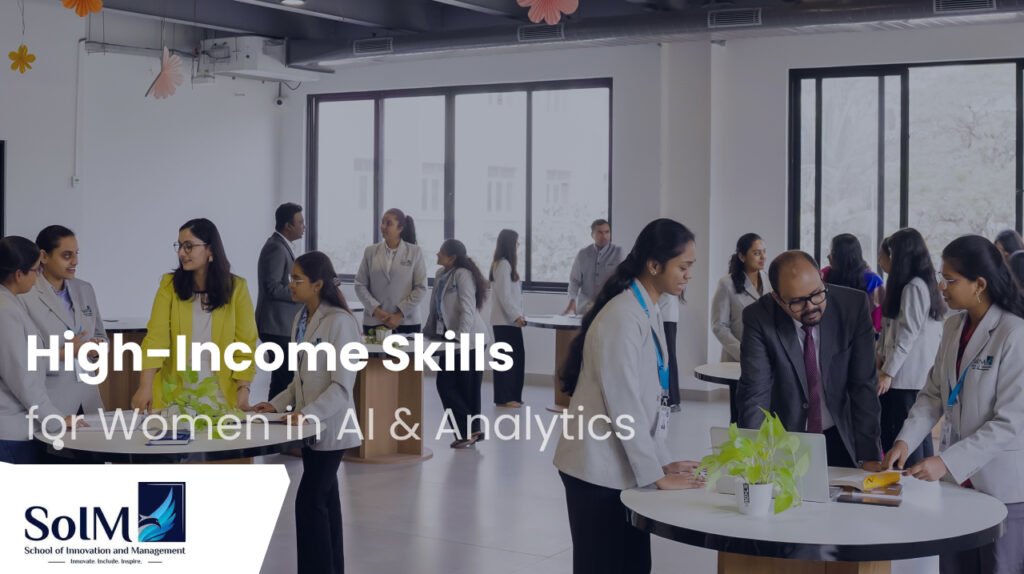
Artificial intelligence has moved beyond the experimental phase in IT departments to become the functional infrastructure of modern business. For professional women, this shift presents a specific set of risks and a clear path toward higher leverage. Middle-management and administrative layers—roles historically held by women—are the most susceptible to automation. However, the gap between technical execution and business strategy is where the talent shortage is most severe.
Securing a high-income career now requires moving beyond execution. It is about governing, interpreting, and leveraging data to protect margins and drive growth.
The Economic Logic of Skill Adaptation
The market does not compensate for effort; it compensates for value and scarcity. As AI models automate routine writing, basic data entry, and schedule management, the market value of those tasks is approaching zero. Professional longevity requires a shift into domains where human judgment, organizational context, and complex problem-solving are mandatory.
Moving from Execution to Strategy
Many women have been channeled into execution-heavy roles, such as marketing coordination, HR administration, or operations management. While AI excels at execution, it cannot set strategy. The necessary pivot involves moving from producing the report to defining what the data implies for the company’s next fiscal year.
Defining High-Value Skills
A high-income skill in the current economy meets three criteria:
- Leverage: Does it allow you to move the needle on revenue or cost savings?
- Scalability: Can it be applied across different departments or projects?
- Irreplaceability: Can an AI agent do this autonomously? If the answer is no, the market value remains high.
High-Demand Roles in Data and AI
The technology sector is often viewed through the lens of engineering, but the democratization of data tools has lowered the barrier to entry for non-engineers. Businesses do not just need more builders; they need professionals who understand user behavior, market dynamics, and operational efficiency.
Diverse teams build better models. There is an increasing corporate awareness that homogenous teams produce biased algorithms, creating financial and reputational risk. Companies are actively recruiting women with data literacy to ensure products serve the entire market, not just a specific demographic.|
Top 10 High-Income Skills to Master
1. Advanced Prompt Engineering and AI Orchestration
Knowing how to interact with a Large Language Model (LLM) is the new literacy. This is not about asking a chatbot to draft an email. It involves understanding context windows, few-shot prompting, and chain-of-thought reasoning to generate complex business outputs. High-earners know how to build multi-step workflows that integrate AI into existing operations.
2. Strategic Data-Driven Decision Making
Data creates noise. The skill lies in filtering that noise to find the signal. This requires looking at a dashboard and identifying which metrics actually impact the bottom line versus which are merely “vanity” metrics. It demands statistical intuition—understanding the difference between correlation and causation.
3. Business Intelligence (Tableau, PowerBI)
You cannot influence what you cannot visualize. Proficiency in BI tools like Tableau or Power BI enables you to transform raw data into interactive dashboards that executive teams rely on. This is a technical skill that grants immediate visibility and authority within an organization.
4. AI Ethics, Policy, and Governance
As regulatory environments in the EU and US tighten, the demand for compliance officers who understand AI is rising. This role involves auditing algorithms for bias, ensuring data privacy (GDPR/CCPA), and establishing corporate governance frameworks to mitigate risk.
5. Data Storytelling
Technical competence fails if it cannot persuade. A data storyteller takes a specific insight—such as “customer churn increased by 5%”—and builds a narrative that explains the cause and proposes a solution. This is a persuasion skill backed by hard evidence.
6. Predictive Analytics and Forecasting
Retrospective analytics looks backward. Predictive analytics uses historical data to model future outcomes. Skills in this area allow you to answer questions about price elasticity, customer retention, and supply chain stability. This is essential for any role involving financial planning.
7. Functional Proficiency in SQL and Python
You do not need to be a software engineer, but knowing SQL (Structured Query Language) allows you to extract data without waiting for the IT department. Python is the primary language of data science; understanding the basics allows you to automate repetitive scripts and communicate effectively with technical teams.
8. AI Product Management
AI products are probabilistic, not deterministic. They behave differently from traditional software. Product managers who understand the lifecycle of an AI feature—from data collection to model training and deployment—are currently among the highest-paid professionals in tech.
9. Process Automation and Workflow Optimization
This involves using tools like Zapier, Make, or RPA (Robotic Process Automation) to connect disparate software systems. If you can automate a manual process that saves a department 20 hours a week, you have created a quantifiable value proposition for your next salary negotiation.
10. Change Management for Digital Adoption
Technology fails when humans refuse to use it. Change management is the psychological side of technical deployment. It involves managing stakeholder expectations, training teams, and overcoming organizational inertia. This remains a core leadership function.
Table 1: Skill Application and Business Impact*
| Skill Set | Practical Application | Business Value |
|---|---|---|
| SQL & Python | Direct database querying and data manipulation. | Reduces IT bottlenecks; increases operational agility. |
| Data Storytelling | High-level board presentations and reporting. | Secures budget and drives organizational buy-in. |
| AI Governance | Compliance auditing and ethical framework oversight. | Prevents regulatory fines and reputational damage. |
| Prompt Engineering | Workflow automation and LLM optimization. | Increases individual and team productivity/output. |
Acquiring and Applying These Skills
Target Specific Certifications
Focus on industry-recognized credentials rather than general attendance certificates.
- Google Data Analytics Professional Certificate (Foundational)
- Microsoft Certified: Power BI Data Analyst Associate (Tool-specific)
- IBM AI Engineering Professional Certificate (Technical)
- Certified Analytics Professional (CAP) (Strategic)
Negotiating with Data
When discussing compensation, shift the focus from responsibilities to outcomes. Instead of saying, “I learned Python,” say, “I used Python to automate our weekly reporting, saving the team 15 hours a week and recovering $40,000 in annual productivity.”
The Evolution of Professional Roles
| Traditional Role | AI-Enhanced Role | Primary Salary Driver |
|---|---|---|
| Content Writer | AI Content Strategist | Strategic output, editorial speed, and brand consistency at scale. |
| HR Manager | People Analytics Lead | Predicting retention, performance trends, and data-driven hiring. |
| Financial Analyst | Forecasting Specialist | Accuracy of forward-looking models and real-time risk mitigation. |
| Project Manager | Agile Product Owner | Speed to market, feature adoption rates, and ROI optimization. |
Positioning for the Next Phase
The future belongs to the “hybrid” professional. Job security now stems from the combination of domain expertise (marketing, finance, HR) and the technical ability to leverage AI and data. These ten skills are not temporary trends; they are the new requirements for leadership in a data-centric economy.
Pick one skill. Dedicate 30 minutes a day to mastering it. Within a quarter, you will have more leverage than the majority of your peers who are waiting for the “landscape” to settle. The best time to build this leverage is before the market demands it.
FAQ's
No. Modern software handles the heavy computation. You need statistical literacy—the ability to interpret what the numbers mean—and the logic to apply those findings to business problems.
Start with Data Storytelling and Prompt Engineering. These provide immediate utility in any office environment and require no coding. Once comfortable, move to a visualization tool such as Power BI.
AI will replace analysts who only perform data cleaning and basic reporting. It will not replace analysts who provide context, interpret nuance, and guide executive strategy.
For business applications (not engineering), you can become functional in SQL within 4-6 weeks of consistent practice. Basic Python for data tasks typically takes 2-3 months to apply effectively.