
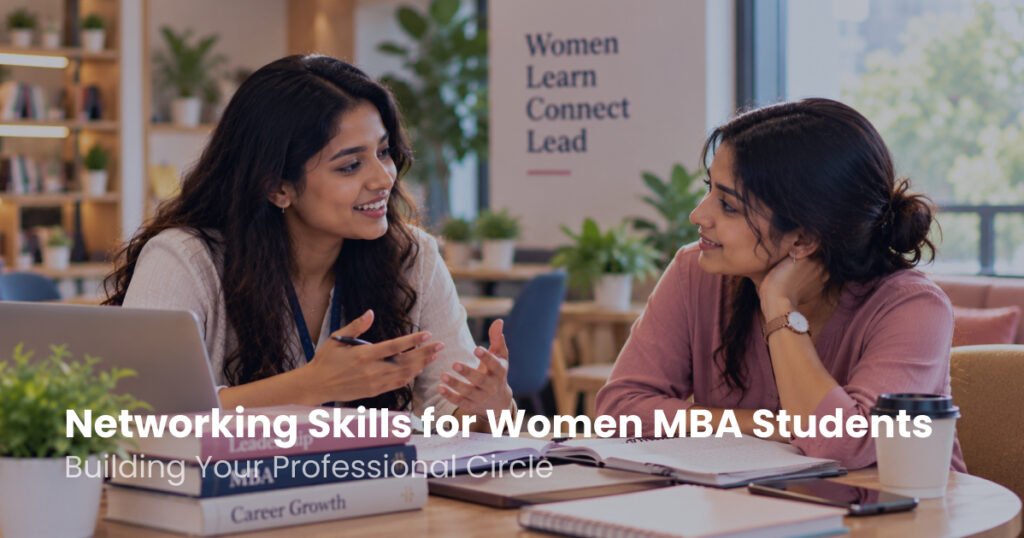
Two students graduate with the same specialisation and the same marks. One receives a referral into a role that was never advertised, because she spent two years talking to people outside her classroom. The other applies through portals and waits. Networking is the difference, and unlike marks it is entirely learnable.
Key Takeaways
- → Weak ties drive most job moves: a five year experiment on 20 million LinkedIn users found moderately distant contacts produced the highest job mobility (Science, 2022).
- → For every 100 men promoted to manager, 93 women are promoted, so a sponsor who names you in a closed room matters more than another acquaintance (McKinsey and LeanIn.Org, 2025).
- → Only 31% of entry level women have a sponsor, against 45% of men at the same level. That relationship has to be built on purpose.
- → Women are just 41% of full time MBA applicants (GMAC, 2025), which makes a women focused campus an unusually dense alumni base for MBA networking.
What does networking actually do for an MBA student?
Networking moves opportunities toward you before they are advertised. A five year field experiment across 20 million LinkedIn users found that weaker ties produced more job mobility than strong ones, and that contacts with roughly ten mutual connections delivered the biggest lift (Science, 2022).
That finding flips the usual advice. The people who help you most are rarely your closest friends. They are the alumnus two batches ahead who now sits on a hiring panel, or the visiting faculty member you spoke to once and thanked properly. Your batchmates know what you know. Distant contacts see a different slice of the market.
Networking also compounds on campus. Group projects, club roles and case competitions put you in front of faculty and practitioners, and those are the people who forward a CV or take a call on your behalf. Read the SoIM placement page as a map of who recruits, then work backwards to the people you need to meet.
CAT 2025 drew close to 2.95 lakh registrations, so every senior you meet cleared a very large filter to get where they are (IIM CAT, 2025). Ask them how they did it, because that question produces better conversations than any elevator pitch.
Why do women MBA students need a deliberate networking plan?
Because the gap opens at the first promotion and it is about advocacy, not ability. For every 100 men promoted into manager roles, 93 women are promoted, and women hold 29% of C suite positions (McKinsey and LeanIn.Org, 2025). A circle that only offers advice will not close that gap. A circle that offers sponsorship can.
The pair of numbers worth memorising is 31 and 45: the share of entry level women who have a sponsor, against men at the same level. A mentor explains how the game works. A sponsor says your name in a room you are not standing in.
That is a reason to network with intent, not less. Say which role you are targeting, ask for one specific introduction, and report back when you act on it. Vague requests such as let me know if you hear of anything are easy to ignore.
The structural picture backs this up. Women remain a minority of full time MBA applicants worldwide at 41%, even though applications from women grew 6% in 2025 against 1% from men (GMAC, 2025). On a women focused campus you inherit a dense, reachable alumni network, so use it hard and then step outside it on purpose. If the credential question is still open, our guide to PGDM vs MBA in Hyderabad explains how recruiters read each one.
The four circles to build before your second term
Your network needs four rings, and they work best in a fixed order. Spend term one on the inner two, then widen. Most students over invest in the first ring and never reach the third, which is exactly where referrals live.
| Circle | Who to approach | What it unlocks | Your first move |
|---|---|---|---|
| Peers and seniors | Batchmates, second year students, club leads | Interview debriefs, shared notes, campus referrals | Join one club and take a visible role |
| Faculty and programme office | Professors, placement cell, alumni relations | Recommendations, live projects, warm introductions | Meet two professors during office hours |
| Alumni two to five years ahead | Graduates now working in your target sector | Role intelligence and internal referrals | Ask for twenty minutes, not a job |
| Industry contacts | Visiting faculty, guest speakers, case judges | Early signal on the skills employers now pay for | Send a thank you note with one question |
Ring three carries the most weight and gets the least attention. Alumni two to five years ahead remember the interview process in detail, still have hiring influence, and are close enough in age to answer honestly. Write one name into each row within your first month, then review the list every fortnight. A circle with no name in it is a wish, not a network.
Want to build that circle on a campus built around women leaders?
SoIM runs a two year PGDM in Hyderabad with clubs, live projects and an alumni network you can reach from week one.
How do you start conversations when you have nothing to offer yet?
Ask about a decision the other person has already made. Questions about choices get answered, while questions about opportunities get deflected. Keep three openers ready: how did you choose between analytics and finance for your first role, what did you change about your CV after placement season, and which skill did you underestimate in year one.
Then reuse what you already wrote. Your MBA statement of purpose contains a paragraph that names your target role in plain language. That paragraph is your answer when a stranger asks what you are working toward, and it sounds rehearsed for the right reason.
Close the loop every time. Send a two line thank you within a day, add the one thing you found useful, and set a reminder to update that person once you act on their advice. The update is the step everyone skips, and the one that turns a conversation into a contact who remembers you.
The same discipline shows up in selection. If you can hold a conversation about someone else’s work for ten minutes, you are already rehearsing for the MBA group discussion and personal interview round, where listening scores higher than reciting.
Three habits that keep a network alive after the event
Contact lists decay quietly. Weak ties fade fastest because nothing in your calendar reminds you to reach out.
The first habit is one useful message a week: a link, a statistic, a job posting, with no ask attached. The second is tracking people rather than events, in one sheet with name, context, last contact and next nudge. Twenty rows beat two hundred business cards. The third is reporting back, because when advice visibly works, the person who gave it becomes invested in your next step.
Habits compound faster than credentials. A student who sends fifty useful messages across two years ends up with people who answer on a Monday morning.
How do you know whether your networking is working?
Count requests you did not initiate, not contacts you collected. If a recruiter mentions a role before it is posted, or a senior asks for your update, the network is functioning. Run a quarterly check with names on both sides: how many people did you help, and how many helped you. If one side is empty, the balance is off.
Two signals say it is not working. You cannot name an alumnus two batches ahead, or every message you send opens with an ask.
Finally, check the structure around you. AICTE publishes the approval status of management institutions, and NTA runs CMAT for AICTE approved programmes. Knowing which exam the people you meet actually wrote gives you a better opener than any script, and it tells you whether the network you are building sits inside programmes employers genuinely recruit from.
A good network is not a collection of favours owed. It is a group of people who can describe what you are good at without checking their notes.
Ready to start building your professional circle?
Applications for the SoIM PGDM are open. Review the process before the next intake closes.