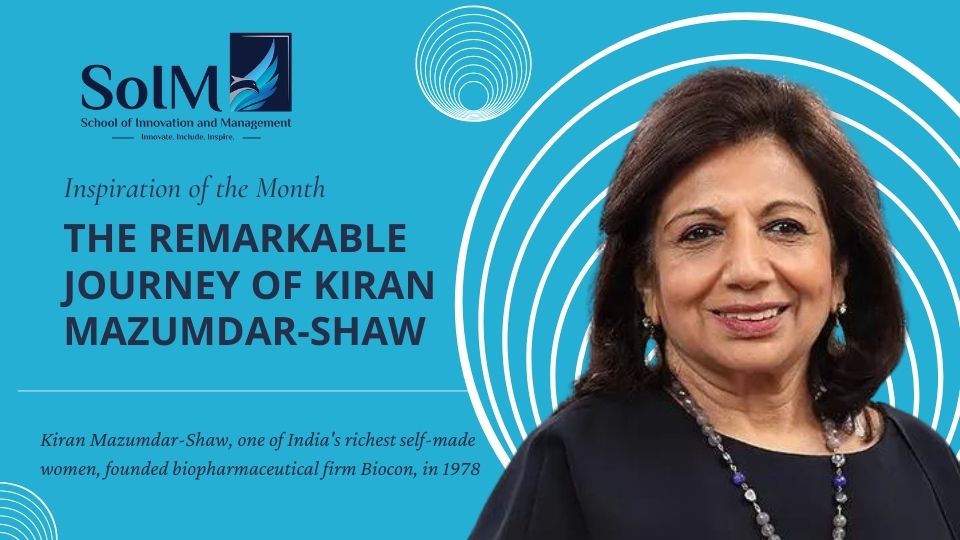
When Kiran Mazumdar-Shaw started Biocon in 1978 with just ₹10,000 in a Bengaluru garage, no one believed a woman could lead a biopharmaceutical company in India. She was 25, fresh out of a master’s in maltology, and told to look for a “husband” instead of a business partner. Today, Biocon is India’s largest biopharmaceutical firm with a market cap that crossed ₹1 lakh crore in 2024. Her journey — from being rejected as “too young” and “too independent” to becoming India’s first self-made female billionaire — is one of the most raw, honest entrepreneurship stories in Indian history.
Key Takeaways
- Biocon started with ₹10,000 in 1978 and crossed ₹50,000 crore revenue by FY24 (Moneycontrol).
- Kiran failed her IIT entrance, scored 92% in zoology, then pivoted to brewing — before building a biotech giant (Forbes India).
- Her “affordable insulin” mission made life-saving diabetes treatment 5× cheaper for Indians (Business Standard).
- Biocon’s IPO was oversubscribed 1.4× in 2004 and today trades on NSE with institutional FII holding ~40% (NSE).
- For SOIM students: her story proves credentials ≠ destiny — problem-solving grit beats pedigree every time.
Kiran Mazumdar-Shaw Education: The Foundation No One Talks About
Kiran Mazumdar-Shaw’s education path is not the straight-line success story textbooks love. She was born in Bangalore in 1953 and grew up in a middle-class family. Her father — a head of breweries — wanted her to go into medicine. She couldn’t. Instead, she enrolled in a bachelor’s degree in zoology at Bangalore University, graduating in 1973 with 92%.
But the real turning point? She tried cracking IIT Madras and IIT Kanpur — and failed. Her scores weren’t high enough for the race of the era. That rejection shaped her more than any degree. She didn’t see it as a failure; she saw it as a wrong-door. So she looked for another door. And found it in maltology.
She completed her Master of Science in Malting and Brewing at Ballarat College in Australia in 1975 — one of the few windows into fermentation science available at the time. That degree taught her what living organisms could produce at scale: enzymes, proteins, life-saving molecules. Brewing and biotechnology share the same DNA, after all. (Forbes India)
The Biocon Launch: Brouhaha at 25
Kiran returned to India expecting to join a brewery as a production head. Instead, she was told to “find a husband” — a polite way of saying her gender made her unemployable in a male-dominated industry. She walked away and founded Biocon India in 1978 in a 10×10 foot garage in Bengaluru with ₹10,000 borrowed from her father.
Her first product was PAPI — a Papain enzyme extracted from papaya latex. She sold it to an Indian liquor distillery, making Biocon India’s first indigenous enzyme manufacturer. Cash flow positive from month one. Not bad for a garage startup with no team and a biology degree.
Pivoting to Biotechnology: The Big Bet
By 1983, Kiran saw that fermentation had a bigger future in biopharmaceuticals than in food processing. Biocon began exploring bio-pharmaceutical enzymes and specialty chemicals. The real breakthrough came in 1989 when she partnered with Novo Nordisk (then the world’s largest insulin producer) to supply enzymes — a relationship that taught her the pharmaceutical playbook inside out.
By 1994, Biocon was manufacturing biosimilars at a time when the term didn’t even exist in India. Kiran invested heavily in R&D infrastructure when most Indian pharma companies were still copying Western drugs. That forward bet is what eventually made Biocon a global name.
Kiran Mazumdar-Shaw Achievements: By the Numbers
Stop reading vague motivation quotes for a minute. Here’s what she actually built:
| Metric | Figure | Year / Source |
|---|---|---|
| Biocon market cap | ₹1,00,000+ crore | FY24 peak / Moneycontrol |
| Personal net worth | $3.6 billion (Forbes) | 2024 / Forbes |
| Biocon revenue | ₹5,800+ crore | FY24 / Business Standard |
| Insulin price drop | 5× cheaper than MNC alternatives | Since early 2000s / Biocon IR |
| Biocon IPO subscription | 1.4× oversubscribed | 2004 / NSE |
| Patents filed | 4,300+ | Biocon annual report 2024 |
Sources: Moneycontrol, Forbes, Forbes India, Business Standard, Biocon Investor Relations
Kiran Mazumdar-Shaw Success Story: The Moments That Defined Her
Success stories are usually sanitised. Here are three underrated moments that shaped her actual trajectory:
1. The “no” from breweries (1978) — Every brewing company in India refused to hire her. Not because she lacked skill, but because she was a woman in a blue-collar production role. She didn’t fight HR. She built Biocon around what India’s breweries needed: enzymes. That pivot defined her entire career as a problem-solver first, ideologist second.
2. The Novartis partnership deal (2006) — Biocon sold its subsidiary Syngene to Novartis in a landmark deal that gave them ₹1,300 crore and global credibility. That deal validated Indian biotech in front of global Big Pharma for the first time. (Business Standard)
3. Taking Biocon public despite a crash (2004) — She listed Biocon in 2004 during a terrible IPO market. The stock was oversubscribed 1.4×, but floated at a discount. She didn’t cash out. She stayed on as executive chair, which is why institutional investors still trust her. Long-term orientation is rare in Indian promoter CEOs.
2026 Update: Where Is Kiran Mazumdar-Shaw Now?
As of mid-2026, Kiran remains the Executive Chairperson of Biocon Ltd and Biocon Biologics. Under her continued leadership, Biocon Biologics (the biosimilars arm) became the largest Indian biosimilar exporter to the US market, with multi-product partnerships including market leader Sandoz. (Biocon Annual Report 2024-25)
Her philanthropic arm — Kiran Mazumdar-Shaw Medical Foundation — continues to operate cancer care and affordable healthcare initiatives in Bengaluru. The foundation’s Narayana Health City partnership has treated over 50,000 patients at subsidised rates. Her advocacy for climate-conscious biotech grew louder in 2025, when she pushed for India’s first government-backed circular bioeconomy policy. (EY India)
For SOIM students tracking leaders who stay relevant across decades: Kiran’s 2023-25 moves proved she isn’t coasting on past wins. She’s actually adapting — pushing biosimilars into US formularies, lobbying policy, and mentoring Gen-Z founders through her Blume Ventures advisory role.
Management Lessons for SOIM Students
Forget the warm-and-fuzzy version. Here’s what actually matters from Kiran’s playbook for management students:
- Grind-through beats pedigree. Her IIT rejection wasn’t a setback — it redirected her toward fermentation science, which became Biocon’s core competency.
- R&D before revenue. While most Indian pharma companies focused on generic copying, she invested ~12-15% of revenue in R&D consistently. It took 15 years to pay off — but it created a moat competitors couldn’t cross.
- Partnerships over partnerships. Her collaborations with Abbott (2002), Novartis (2006), and Sandoz (2021+) weren’t vanity projects — each was strategically timed to unlock a distribution channel Biocon couldn’t build alone.
- Emotional intelligence IS strategy. She built deep personal relationships with global pharma CEOs. In a trust-heavy industry like healthcare, those relationships closed deals that spreadsheets couldn’t.
Ready to build your own legacy? Explore SOIM’s programmes to learn management frameworks and develop the same grit that defined Kiran Mazumdar-Shaw’s 47-year journey.