
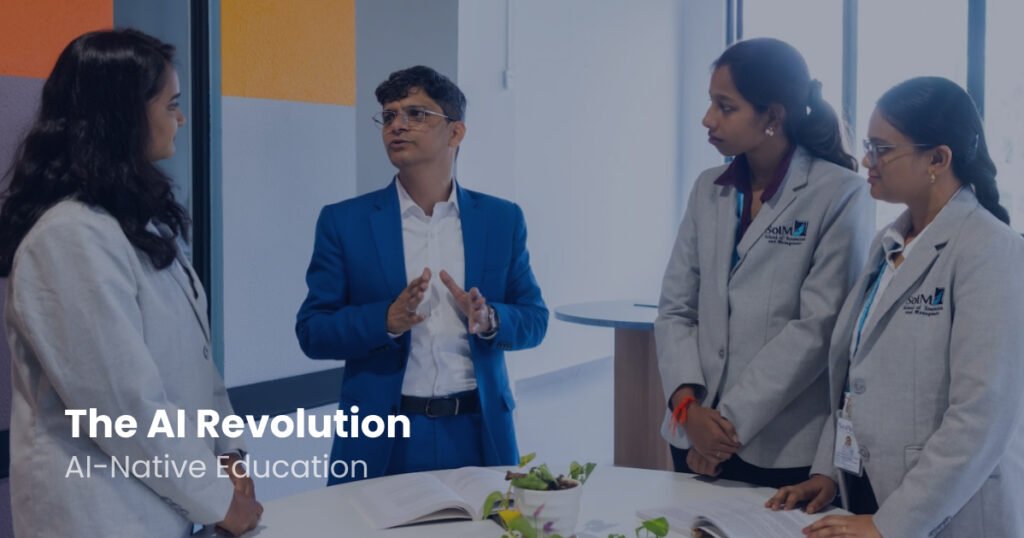
The Shift to Algorithmic Governance: Why Women Require an AI-Native Education
Artificial Intelligence has moved beyond the experimental phase in the IT department and is now a foundational component of corporate governance. It is actively redefining how decisions are structured, how teams are scaled, and how organizations maintain a competitive edge. As this shift matures, the primary challenge is no longer the technology itself, but the competence of those who manage it.
For women in business, this era presents a specific set of challenges and a significant strategic opening. To secure and maintain authority at the executive level, basic digital literacy is no longer sufficient. Modern leadership requires an AI native education a framework that treats machine learning and algorithmic logic not as external tools, but as core components of business strategy. Adapting to this operational shift is the most direct path for female leaders to influence the future of corporate direction.
Defining the AI-Native Mindset in Management
An AI-native education is fundamentally different from traditional technical training. It does not demand that a manager become a data scientist or a software engineer. Instead, it focuses on the strategic orchestration of these technologies. Being AI native means understanding the logic of algorithms well enough to question their outputs, identify their biases, and integrate them into a broader business vision.
In a traditional setting, a manager might request a report and then interpret the findings. In an AI native setting, the manager designs the parameters of the inquiry, understands the data provenance, and knows which specific model is best suited to solve a particular problem. This shift from “user” to “architect” is what distinguishes the next generation of leadership. It allows a professional to oversee technical teams without being intimidated by the complexity of the underlying code.
The New Mandate for Leadership Fluency
Leadership today requires a synthesis of high-level strategy and deep technological fluency. There is a growing mandate for women in AI management leadership because the stakes of algorithmic bias and data ethics have never been higher. Diverse leadership teams are proven to build more resilient, less biased systems. When women hold authority in tech driven spaces, organizations tend to innovate with a greater sense of responsibility and long-term viability.
However, authority is difficult to maintain without technical grounding. If a leader does not comprehend how a model arrives at a recommendation, they are effectively delegating their decision making power to the technical specialists or the algorithm itself. AI native education restores that power to the manager. It provides the vocabulary and the conceptual framework needed to audit an AI strategy as rigorously as one would audit a financial statement.
The Economic Case for AI Literacy Among Women
The historical context of industrial shifts shows that rapid technological changes often impact roles traditionally held by women, particularly in administrative and middle management sectors. The impact of AI on women in business must be viewed through a pragmatic, economic lens.
According to data regarding workplace automation, while generative tools can displace routine cognitive tasks, they also provide a massive lever for professional productivity. The dividing line between being displaced by automation and being empowered by it is proactive upskilling. Women who understand how to command these systems move from performing manual oversight to managing the automated systems that execute those tasks. This transition is not just about job security; it is about moving into higher value roles that command greater compensation and influence.
Transitioning from Traditional to AI-Native Management
| Traditional Management | AI-Native Management |
|---|---|
| Manual data aggregation and retrospective reporting | Real-time predictive analytics and prescriptive modeling |
| Human-led coordination of administrative workflows | Oversight of AI agents and automated process chains |
| Iterative brainstorming for market positioning | Data-driven sentiment analysis and generative strategy |
| Intuition-based risk assessment | Algorithmic risk modeling and stress testing |
| Human-centric talent acquisition | Audit and oversight of AI-driven recruitment systems |
Overcoming the Structural Barriers to Technical Authority
A visible divide remains in who is pursuing tech-integrated leadership credentials. Bridging the gender gap in AI education is critical for organizational health and executive parity. Many professional women face “technical intimidation” a result of a male-dominated tech culture that often uses jargon to gatekeep information.
AI-native programs dismantle these barriers by framing artificial intelligence as a practical instrument for solving operational problems rather than an abstract programming challenge. By focusing on the “management” of AI rather than just the “development” of AI, these programs make the technology accessible to those whose strengths lie in strategy, ethics, and personnel management. This approach encourages a broader demographic of women to step into high stakes leadership roles where technology and business intersect.
Strategic AI Management and the C-Suite
For those targeting the C-suite, AI literacy for female executives is now a prerequisite for credibility. Stakeholders and board members expect leaders to explain how machine learning will impact the company’s bottom line, risk profile, and market share.
If an executive cannot speak with authority on AI risk management, data privacy frameworks, or the return on investment for automation, they will likely be sidelined during critical strategic planning. Executive presence now requires the ability to lead a “technical audit” asking the right questions of the CTO to ensure that the technology is serving the business goals, rather than the business being driven by the limitations of the technology.
Educational Pathways: Moving Beyond Theory
The benefits of an AI native business degree are found in the transition from theory to practical application. Investing in a modernized curriculum provides a professional toolkit that is both resilient and adaptable.
For example, integrating business acumen with specialized tracks like business analytics allows a professional to translate vast, unstructured data into actionable market strategies. This is no longer the job of a junior analyst; it is the job of the manager who must decide where to allocate capital. Similarly, those focused on financial services must now understand algorithmic trading and automated risk assessment to remain relevant. These educational pathways transform a professional from someone who reacts to market trends into someone who uses data to predict and drive them.
Governance and the Ethics of Generative AI
The rise of generative models presents a unique management challenge. Cultivating generative AI management skills involves more than just knowing how to use a chatbot. It requires a framework for governing the use of these tools within an organization.
Leaders must establish protocols for data security, intellectual property, and output validation. This involves “human in the loop” management, where AI handles the heavy lifting of content generation or data processing, while the manager provides the nuanced quality control and ethical oversight. Women who master this governance become indispensable because they protect the organization from the reputational and legal risks associated with unmanaged AI.
Challenges vs. Strategic Opportunities
| The Challenge | The AI-Native Opportunity |
|---|---|
| Algorithmic bias in hiring and lending | Implementing transparent and ethical AI auditing frameworks. |
| Potential for routine task displacement | Shifting to high-impact roles in AI strategy and oversight. |
| Underrepresentation in technical roles | Leading the bridge between technical teams and business units. |
| Keeping pace with rapid software changes | Focusing on foundational AI logic that outlasts specific tools. |
AI as a Catalyst for Professional Autonomy
Strategic AI management for women leaders is about using technology to amplify existing professional strengths. Competencies such as complex problem solving, high stakes communication, and empathy are not easily replicated by algorithms. However, when these human skills are paired with AI fluency, the result is a formidable leadership profile.
By automating the mundane aspects of management such as scheduling, basic reporting, and data entry women can dedicate more time to high value activities like mentorship, strategic networking, and long term planning. In this sense, AI does not replace the manager; it removes the “noise” from her day, allowing her to focus on the work that actually moves the needle.
The Future of Management Education
The future of management AI education is grounded in personalization and integration. Leading institutions are no longer treating AI as an elective. It is becoming the core of the MBA and PGDM curriculum. For women, this is an opportunity to reset the playing field.
By entering these programs now, women can position themselves as early adopters and experts in a field that will dominate the corporate landscape for the next several decades. This is a strategic move that shifts the dynamic from observing a technological shift to directing it.