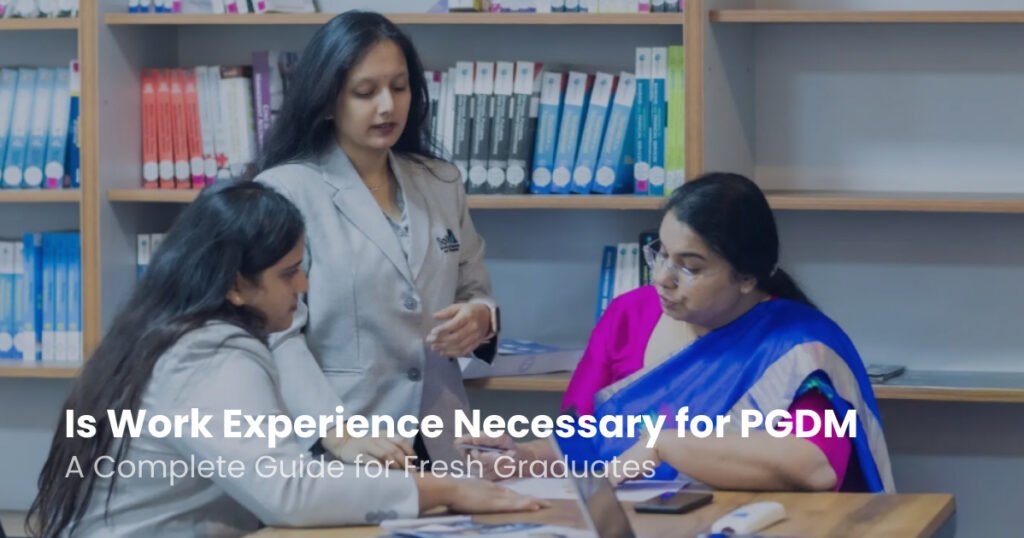
The decision to pursue a Post Graduate Diploma in Management (PGDM) immediately following graduation is often met with a specific concern: the perceived lack of professional experience. Candidates frequently worry that their resumes, currently populated by academic projects and perhaps a single internship, might be insufficient for the rigors of a top-tier business program or the expectations of corporate recruiters.
In reality, the structure of modern management education is specifically designed to accommodate fresh graduates. While executive programs are built for those with substantial tenure, the standard PGDM remains a primary entry point for young professionals looking to transition from academic theory to corporate practice.
The following analysis examines the strategic value of pursuing a PGDM as a fresher, the operational realities of the admission process, and how a lack of work experience can be positioned as a professional asset.
📋 Key Takeaways
- Work experience is NOT mandatory for PGDM — AICTE only requires a bachelor’s degree with 50% marks
- Most top B-schools actively recruit fresh graduates — diversity in cohorts benefits everyone
- Starting your PGDM early means entering the management job market 2-3 years sooner than peers who delayed
- Summer Internship Programs (SIP) often convert to Pre-Placement Offers (PPO) — your internship IS your experience
- Marketing, Finance (for B.Com/Economics grads), HR, and Operations are the most fresher-friendly specializations
Is Work Experience Actually Mandatory for PGDM Admissions?
From a strictly regulatory and admissions standpoint, work experience is not a requirement for a PGDM. The eligibility criteria established by the All India Council for Technical Education (AICTE) focus on academic foundation rather than professional history.
Most reputable institutions require a bachelor’s degree in any discipline with a minimum of 50% aggregate marks. If you are in your final year of study, you are eligible to apply, provided you complete your degree requirements before the program commences.
Business schools do not merely “accept” freshers; they actively recruit them. A diverse cohort requires a mix of perspectives. While a professional with five years in manufacturing brings practical operational knowledge, a fresh graduate often brings higher digital literacy, updated theoretical knowledge, and a more flexible approach to problem-solving. This balance is essential for the peer-to-peer learning model that management programs rely upon.
What Are the Strategic Advantages of Starting Your PGDM Early?
Choosing to enter a management program without a two- or three-year career break offers several pragmatic advantages that impact long-term career trajectories.
Maintaining Academic Momentum
Transitioning from a professional environment back to a classroom setting is a documented challenge for many. The habits required for academic success — rigorous note-taking, examination preparation, and intensive research — are often sharpest immediately following undergraduate studies. Freshers typically navigate the heavy reading loads and quantitative requirements of a PGDM with more agility than those who have been away from formal education for several years.
Accelerated Career Trajectory
Entering the workforce as a management professional at age 23 or 24 provides a significant head start. By the time a peer (who worked for three years before starting their PGDM) enters the post-graduate job market, the direct-entry fresher is often already moving into mid-to-senior management roles. This three-year lead can translate into a substantial difference in cumulative lifetime earnings and earlier access to leadership responsibilities.
The “Molding” Factor in Recruitment
From a human resources perspective, fresh PGDM graduates are highly desirable for Management Trainee (MT) programs. Corporations often prefer to hire candidates who have not yet been conditioned by the specific corporate cultures or operational “bad habits” of other organizations. Freshers are viewed as adaptable and easier to train in company-specific methodologies. They are perceived as a blank canvas upon which a firm can build its future leadership.
PGDM vs. MBA for Freshers: Which Curriculum Suits You Better?
For a graduate with no work history, the choice between a PGDM and a Master of Business Administration (MBA) often comes down to the curriculum’s agility.
The PGDM is an autonomous qualification. Because the institutes are not bound by slow-moving university boards, they can update their syllabi annually. This is critical for freshers. Since you lack the context of a previous job, you need a curriculum that reflects the current state of the industry.
A PGDM typically emphasizes:
- Case-Based Learning: Analyzing real-world business failures and successes to build decision-making skills.
- Skill-Based Certifications: Incorporating industry-recognized certifications (like Six Sigma, Google Analytics, or Bloomberg Market Concepts) into the core credits.
- Extended Internships: Often offering 8- to 12-week summer internships that serve as a bridge to full-time employment.
In contrast, many traditional MBA programs remain anchored in theoretical frameworks. For a student who has never sat in a corporate boardroom, the practical, hands-on nature of a PGDM is usually more effective at bridging the experience gap.
What Is the Real ROI of Doing a PGDM as a Fresher?
When evaluating whether to work first or study now, one must consider the opportunity cost.
If a graduate takes a standard entry-level job after their bachelor’s degree, they may earn a modest salary. However, the salary jump after a PGDM is usually exponential. By skipping the low-earning years between a bachelor’s and a master’s, a student maximizes the number of years they spend earning at a “management” pay scale.
Furthermore, the Return on Investment (ROI) for a fresher is often cleaner. You are not sacrificing a high salary to go back to school; you are investing in the capability to earn that high salary immediately.
How to Crack the PGDM Selection Process as a Fresher
Because you cannot discuss your professional achievements during the admission rounds, your strategy must shift toward demonstrating potential and “coachability.”
The Entrance Exam Phase
Performance in exams like the CAT, XAT, MAT, or CMAT carries significant weight for freshers. These scores act as a proxy for your analytical and quantitative aptitude. A high percentile signals to the admissions committee that you possess the cognitive capacity to handle the program’s rigor, regardless of your lack of experience.
Group Discussions (GD) and Personal Interviews (PI)
In these rounds, panels look for specific behavioral traits:
- Clarity of Purpose: You must be able to articulate why you are pursuing management now rather than waiting.
- Leadership Evidence: Focus on your roles in college festivals, sports teams, or volunteer organizations. These are valid indicators of leadership potential.
- Current Affairs: Since you don’t have industry-specific experience, you are expected to have a broad and deep understanding of the global economic environment.
Leveraging Internships
For a fresher, an internship is the closest equivalent to work experience. When discussing your profile, treat your internship as a professional project. Focus on the problems you solved, the data you analyzed, and the organizational impact you made. This demonstrates that you understand the professional environment, even if your exposure was brief.
Which PGDM Specializations Are Best for Fresh Graduates?
While all management streams are open to freshers, some offer a more natural transition than others.
- Marketing and Sales: This is a top choice for freshers. It relies heavily on creativity, communication, and energy — traits abundant in younger graduates. Companies regularly hire freshers for business development and brand management roles.
- Finance: If you have a strong quantitative background (B.Com, Economics, or Engineering), finance is a viable path. Many investment banks and consultancy firms look for fresh talent they can train in their specific modeling and valuation techniques.
- Human Resources: For those with high emotional intelligence and strong organizational skills, HR provides a stable entry into corporate management.
- Operations/Supply Chain: This is often a preferred route for engineering graduates who want to combine their technical knowledge with management principles.
Do Companies Really Reject Fresh PGDM Graduates During Placements?
A common myth is that companies only hire candidates with work experience. Data from top-tier and mid-tier B-schools consistently refute this.
Placement reports generally show a healthy split. While certain “lateral” roles are reserved for those with prior experience, “front-end” roles in consulting, sales, marketing, and finance are heavily populated by freshers. The key is the Summer Internship Program (SIP) — a cornerstone of the two-year PGDM curriculum. A successful internship often leads to a Pre-Placement Offer (PPO), effectively rendering the “lack of experience” argument moot before the final year even begins.
The Bottom Line: Can You Crack PGDM Without Work Experience?
Work experience is a component of a profile, but it is not the defining factor for success in a PGDM. The program is a transformative tool that turns a graduate into a manager.
If you have the academic foundation, the drive to adapt to a fast-paced environment, and a clear vision for your career, the lack of a traditional work history should not deter you. In many ways, starting your management education early is a tactical move that positions you for a longer, more lucrative career in the corporate hierarchy.
At SOIM, we work closely with first-batch students navigating this exact decision every year. Based on our placement data and alumni feedback, the fresher-to-management-track transition is one of the highest-ROI decisions a young professional can make.
Ready to take the next step in your management journey? Explore SOIM’s PGDM programs designed to transform fresh graduates into industry-ready professionals.
Last updated: April 2026 | Admission cycle for 2026-27 now open