
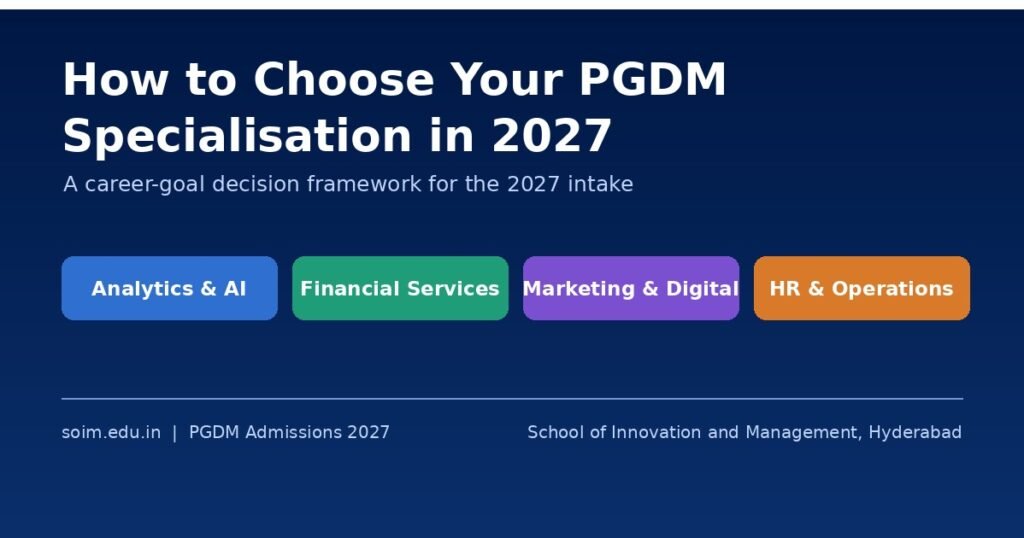
Choosing a PGDM specialisation in 2027 comes down to one question: what work do you want to be doing three years after you graduate? AI, big data and fintech roles top the fastest-growing job list to 2030, and 86% of employers expect AI to reshape how they operate (WEF, 2025). In India, 87% of enterprises already use AI (PIB, 2026). Trends shape demand, but they can’t tell you which track fits you. Your strengths, your target industry and your first job do. Here’s a career-goal framework for PGDM specialisations 2027, plus an honest read on how each route plays out for women.
Key Takeaways
- →AI, big data and fintech specialists are the three fastest-growing roles to 2030, according to employers surveyed by the World Economic Forum (WEF, 2025).
- →India’s AI talent demand is projected to climb from about 650,000 to more than 1.25 million professionals by 2027 (Deloitte-nasscom, 2024).
- →Women now hold 36% of India’s tech jobs and 45.7% of the newest IIM PGP batches (NASSCOM, 2025; Economic Times, 2026).
- →Choose the track from the role you want, then check the electives, capstone and internship that get you there.
 |
What should actually drive your PGDM specialisation decision in 2027?
Start with the role, not the ranking. GMAC’s 2025 survey of 1,108 recruiters across 46 countries found that 90% of employers planned to hire MBA-level talent, and more than a third expected to hire more than the year before (GMAC, 2025). The jobs exist, so the question is which one you’ll be good at on day one.
Every track builds a different skill mix. Problem-solving, strategic thinking and communication lead the current hiring criteria, while AI tool skills and data analysis climb into the top five for five years from now (GMAC, 2025). That’s what a specialisation buys you: a functional base plus the analytical layer that keeps it useful.
Find the row closest to your three-year goal, then note the skills attached to it. If two rows appeal equally, you don’t have a decision problem, you have an information one.
| Your three-year goal | Best-fit track | Skills that matter | Typical first roles | Route at SoIM |
|---|---|---|---|---|
| Build models and forecasts | Business Analytics and AI | SQL, Python, statistics, Power BI | Business analyst, risk analyst | PGDM in Business Analytics |
| Work in markets or fintech | Financial Services | Reporting, valuation, risk, Excel | Financial analyst, credit analyst | PGDM in Financial Services |
| Own a product roadmap | Analytics plus product | Discovery, product metrics, SQL | Product analyst, product manager | PGDM General (analytics) |
| Grow brands and demand | Marketing and digital | Consumer research, performance ads | Brand associate, digital marketer | PGDM General (marketing) |
| Lead people, culture or process | HR and Operations | HR analytics, process design, inventory models | HR associate, operations analyst | PGDM General (HR or operations) |
One more filter: how quantitative the track is. Analytics and financial services lean on statistics from the first trimester, while marketing, HR and operations mix numbers with judgement. Your comfort with maths should outweigh any trend headline. If you’re still weighing the degree itself, our PGDM vs MBA guide for Hyderabad compares both on curriculum and outcomes.
Which PGDM specialisations are growing fastest for the 2027 intake?
Big data, fintech engineering and AI roles are the three fastest-growing jobs in percentage terms through 2030 (WEF, 2025). Those titles sit on top of analytics and finance tracks. Product, marketing and operations roles grow slower, but they’re hiring more people.
Deloitte and nasscom project India’s AI talent demand to rise from roughly 650,000 professionals to more than 1.25 million between 2022 and 2027, while only about 16% of Indian IT professionals are AI-skilled (Deloitte-nasscom, 2024). That shortfall is why analytics graduates get pulled into roles they never applied for.
| Track | Demand signal for 2027 | Source |
|---|---|---|
| AI and data analytics | Fastest-growing roles to 2030; India needs 1.25 million AI professionals by 2027 | WEF 2025; Deloitte-nasscom 2024 |
| Product management | Hiring up 42% year on year; senior roles up 87%, junior roles up 16% | Institute of Product Leadership 2025 |
| Digital marketing | Among the fastest-growing role families to 2030 as digital access expands | WEF 2025 |
| Financial services and fintech | GCC hiring grows four times faster than IT services, adding 160,000 jobs in FY25 | Times of India 2025 |
| HR and operations | Data analysis ranks top three in future skills among consulting recruiters | GMAC 2025 |
There’s one caveat: the steepest growth rates often sit on the smallest absolute numbers, which is why product hiring jumped 42% while junior product roles grew 16% (Institute of Product Leadership, 2025). For the analytics path in detail, see our comparison of Business Analytics and Financial Services.
Are AI, product and digital tracks better than finance right now?
Not universally. AI, product and digital tracks win on growth rates; finance wins on structure and the sheer density of roles across banks, NBFCs, fintech firms and global capability centres. India added around 160,000 GCC jobs in FY25, and that hiring grows four times faster than IT services (Times of India, 2025). Many of those roles sit in risk, treasury, controllership and analytics.
A trend won’t decide this for you. The sharper question isn’t which track is hottest, but which one you want to be senior in at 32. Analytics rewards comfort with messy data. Financial services rewards precision and long client relationships. Product rewards judgement, and it usually wants two or three years of delivery experience first. If analytics is calling, read our take on why women in business analytics shape the global tech economy.
Explore SoIM PGDM Admissions for 2027
How do these tracks play out for women in 2027?
Better than a decade ago, but unevenly across tracks. Women made up 45.7% of the newest PGP batches at the top five IIMs, up from 41.7% the year before (Economic Times, 2026). In the workplace, women hold 36% of India’s tech jobs, double the share of a decade ago, and more than 40% of postgraduate STEM enrolment is female (NASSCOM, 2025).
Analytics and AI have the deepest female pipeline because the STEM supply is already there, and product organisations report women at 25% to 35% of their teams, up from 15% to 20% in 2022 (NASSCOM, 2025). Financial services hires steadily, though front-office roles still skew male, so favour firms with rotation programmes. Marketing and HR lead fastest to people leadership, where analytics literacy now separates competing candidates.
What decides outcomes is support, not the label on the track. NASSCOM’s research on women in India’s product ecosystem found that mentors, flexible work and upskilling keep women in the pipeline, and over 60% of respondents rated inclusive leadership and bias-free evaluation as the key retention factors (NASSCOM, 2025).
A five-step framework you can act on this month
Let’s work through these five steps in order. It takes an hour and can save two years.
- Name the role, not the industry. “Business analyst at a global capability centre” beats “analytics”.
- Audit your own evidence. Which subjects did you enjoy enough to study without being asked?
- Match the curriculum, not the brochure. Compare trimester-one core courses and elective lists, starting with the PGDM in Business Analytics and PGDM in Financial Services structures.
- Check the last mile. Ask where the previous batch interned, and in which functions.
- Test it cheaply. Finish one free analytics or finance certification before you commit.
Mistakes that make graduates regret their specialisation
Three patterns recur. The first is choosing a track because it was popular the year you applied, which leaves you competing against an unusually large batch for the same roles. The second is picking a specialisation that doesn’t match your appetite for quantitative work, which turns two years into a grind. The third is ignoring the internship pathway, because a summer placement often converts into the full-time offer.
None of these mistakes is fatal, and most can be fixed in year two with electives and a capstone project. But corrections cost momentum, and momentum lands the better role. Choose with the evidence in front of you, then revisit the decision every trimester. Compare programme routes on our guide to PGDM colleges in Hyderabad, then see where each track leads on the SoIM placements page.