A career break of two years used to close doors in Indian hiring. That is changing. Returner programmes, skills-first screening, and a talent shortage in analytics and digital roles have shifted how recruiters read a gap on a CV. For women planning a return, the question is no longer whether the break is a problem. It is how to present the years that follow.
Key Takeaways
- → A career break is usually a positioning problem, not a qualification problem. Recruiters screen on recent activity, so the fix is to add current work rather than explain the gap.
- → A PGDM converts the gap into documented current activity through internships, live company projects and coursework (GMAC corporate recruiters survey, 2025).
- → Returner hiring in India is concentrated in technology, financial services and healthcare, where talent shortages are persistent and structured second-career programmes now exist.
- → Analytics, digital marketing and HR analytics are the specialisations that most often connect prior experience to a growing function.
Why Does a Career Break Still Feel Like a Barrier?
A career break still feels like a barrier because hiring has historically screened on continuity rather than capability. Recruiters working through hundreds of applications use recent experience as a shortcut. A gap interrupts that shortcut, so the CV never reaches the shortlist even when the skills are current.
The data suggests the barrier is smaller than the perception. Research on returner hiring consistently finds that candidates who reach interview stage convert at comparable rates to continuous-employment candidates (LinkedIn Talent Solutions, 2024). The dropout happens earlier, at screening. Reports from Indian industry bodies on women’s workforce participation point to the same pattern (NASSCOM, 2025).
There is also a confidence effect. A 2023 study of Indian women professionals found that returning candidates consistently rated their own readiness lower than hiring managers did. The gap was in self-assessment, not ability.
What this means practically: the problem is usually positioning rather than qualification. A candidate with five years of marketing experience and a two-year break still has five years of marketing experience. The CV needs to say so clearly and quickly.
What Do Recruiters Actually Look For in a Returner?
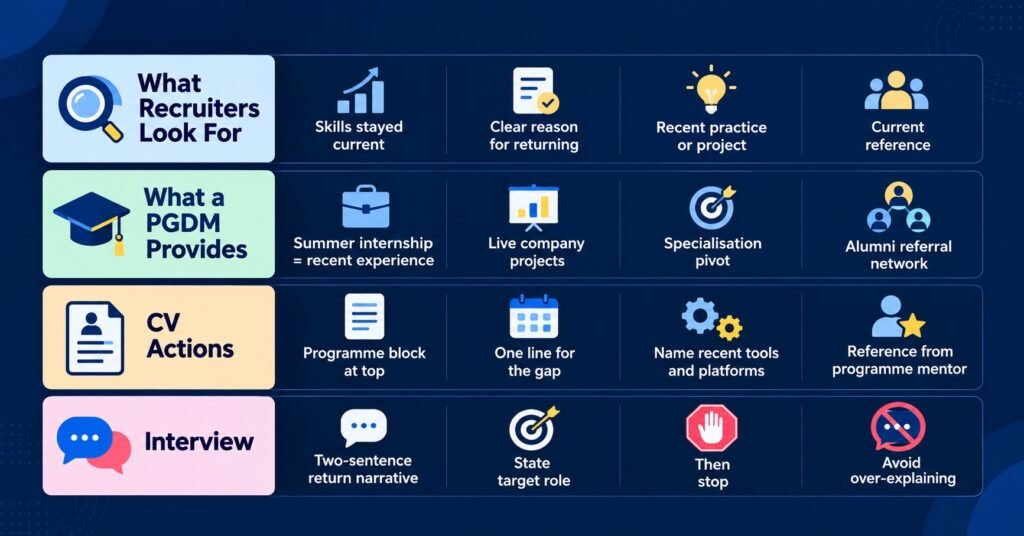
Recruiters look for evidence that skills stayed current and that the candidate has a clear reason for returning now. Those two things carry more weight than the length of the gap. Employer surveys on graduate hiring consistently rank demonstrated skills and communication above tenure as selection criteria (GMAC Corporate Recruiters Survey, 2025).
Skills currency is the first signal. A hiring manager wants to know whether you have kept up with the tools and methods in your field. For marketing, that means analytics platforms and content systems. For finance, it means reporting tools and current compliance frameworks. For operations, it means process automation and data handling.
A clear return narrative is the second signal. Interviewers are not assessing whether the break was legitimate. They are assessing whether the candidate has thought about the return. A specific answer, such as a target role and a reason for choosing it, reads as preparation. A vague answer reads as uncertainty.
Third is some form of recent practice. This is where a PGDM does specific work. A structured programme generates recent coursework, live projects, and an internship, all of which sit on the CV as current activity rather than a gap.
Reference strength still matters. Returners often underestimate how much weight a former manager’s recommendation carries, particularly in Indian hiring where networks drive a large share of mid-level placements.
How Does a PGDM Help Women Restart a Career?
A PGDM helps by converting an employment gap into a period of documented, current activity. That is the core mechanism, and it changes how the CV reads.
The internship component matters most for returners. Most PGDM programmes include a summer internship, which produces recent work experience with a current employer. That single line moves a candidate from “out of the workforce” to “recently active in a professional environment.”
Live projects add a second layer. Consulting-style projects with real companies generate deliverables, presentations, and client contact. For a returner, these are portfolio pieces that did not exist before the programme.
The specialisation choice becomes a deliberate pivot point. Someone returning from a break in a declining function can move into a growing one. Women moving from teaching into learning and development, or from accounting into financial analytics, use the PGDM year to make that shift credibly.
Placement support matters more for returners than for freshers. A candidate with prior experience is often easier to place, but only if the network reaches the right employers. Programmes with established recruiter relationships and alumni referrals give the returner a channel the open market does not.
The cohort itself is part of the value. Studying alongside women at different career stages normalises the return. It also produces a peer network that persists after graduation, which matters in sectors where referrals drive hiring.
What Are the Returner Trends in India Right Now?
Returner hiring in India is growing, and it is concentrated in specific sectors. Technology, financial services, and healthcare are the most active, largely because those sectors face persistent talent shortages.
Companies have formalised the process. Several large Indian employers and multinationals with Indian operations now run structured second-career programmes, with defined onboarding and a supported ramp-back period. These programmes typically target candidates with two or more years of prior experience.
The shift to skills-based hiring supports the change. Where screening tools score candidates on demonstrated skills rather than tenure, a gap carries less weight. Roles in analytics, digital marketing, and operations are the most likely to be assessed this way.
Remote and hybrid working has also widened the map. A returner in a smaller city can now hold a role based in a metro, which removes geography as a constraint that disproportionately affected women re-entering the workforce.
Women’s participation in business education reflects the same direction. Female enrolment in management programmes has risen steadily, and women now make up a substantial share of the newest cohorts at leading Indian institutes (AICTE, 2025). Government data on women’s labour-force participation shows a parallel upward trend (Ministry of Statistics, MoSPI, 2024). The pipeline is there.
Which PGDM Specialisations Work Best for a Career Break?
The best specialisation for a returner is the one that connects prior experience to a growing function. That usually means adjacent rather than complete change.
Analytics and business analytics suit returners from finance, operations, or research backgrounds. Prior domain knowledge shortens the learning curve, and demand for data-literate managers remains strong across sectors.
Marketing with a digital focus works well for candidates from communications, retail, or client-facing roles. The shift to digital channels means employers value recent platform knowledge, which coursework supplies.
Human resources and organisational behaviour attract many returning women, partly because the function values maturity and communication. It is also highly competitive for that reason, so specialising in a sub-area such as HR analytics differentiates.
Financial services suits candidates with prior accounting or banking experience who want to move into analysis or compliance rather than transaction processing. The domain knowledge transfers directly.
A woman with no strong preference should weight the specialisation by hiring demand rather than personal interest alone. Interest predicts completion. Demand predicts placement.
How Do You Present the Break on a CV?
Present the break plainly and then move quickly to what follows. Recruiters read the most recent lines first, so the format matters more than the explanation.
Use functional or hybrid formatting for the current period. Lead with a “Programme” or “Professional Development” block that names the PGDM, the specialisation, and the internship. This places current activity above the older employment history.
Keep the gap line short and factual. One line stating the dates and a neutral reason is enough. Long explanations invite scrutiny and shift focus away from current capability.
Name the tools and platforms you have used recently. Specificity reassures the screening tool and the human reader. “Advanced Excel and Power BI project work” reads better than “analytical skills.”
Get a current reference. A programme mentor, project sponsor, or internship supervisor can speak to your recent work. That reference is more useful to a recruiter than one from two years ago.
Prepare a two-sentence return narrative for interviews. State the target role and why you want it. Then stop talking and let the interviewer respond. Over-explaining is the most common mistake returners make.
Where Does a PGDM Fit If You Are Not Sure?
A PGDM can also function as a decision year. Many returners enter without a fixed target and use the programme to test directions through electives, live projects, and the internship.
That approach carries less risk than it sounds. Electives give exposure to several functions before a commitment. Live projects show what the work is actually like rather than how it is described.
Capstone projects are useful for this. A single substantial project in a new area provides both the experience and the evidence.
A note on pace. A returner is often older than the average cohort member and may feel that difference. Employers do not screen on cohort age. They screen on capability and fit, and prior work experience reads as an advantage rather than a delay.
Plan the Return Before You Leave the Break
The most useful step for a woman planning a return is to start before the break ends. Applications, applications to shortlist, and programme timelines all take longer than most candidates expect.
Two things are worth doing first. Map your prior experience to a growing function, then identify the programmes whose placement records reach employers in that function. Those two decisions determine most of the outcome.
The PGDM year is not a pause in a career. It is a documented, current period of skill-building, project work and employer contact, which is exactly what the screening process is looking for. The women who return successfully are usually the ones who treated it as a deliberate step rather than a waiting period.
If you want to understand how the programme is structured for women at different career stages, explore our PGDM programme and admissions process, review our placement record, read our guide to choosing a PGDM specialisation for 2027, or talk to our admissions team about your specific situation. Women returning after a break are a group we work with directly.